China’s Solar Light Tower industry has become an important source for construction sites, road projects, emergency services, and outdoor events. Chinese manufacturers now offer compact LED towers, trailer-mounted systems, and hybrid solar-diesel models. Their product choices differ widely.
As solar photovoltaic researcher Dr. Martin Green has stated, “Solar energy is the most abundant energy resource on Earth.” This idea becomes practical when a tower stores sunlight during the day and delivers steady illumination after sunset. In a real worksite, the details matter. A reliable unit should provide bright LED output, a stable trailer frame, weather-resistant panels, and batteries that survive repeated nighttime cycles.
This guide examines China’s top Solar Light Tower manufacturers through product quality, technical experience, certifications, customization, and after-sales support. It also considers less visible factors, including controller performance, charging time, battery replacement, and spare-parts availability. A low quoted price can look attractive. It may become expensive when the mast jams or the battery weakens early.
No supplier is perfect. Some manufacturers communicate clearly but offer limited customization. Others build impressive samples but provide uneven support after shipment. Buyers should inspect factory records, request operating data, and test light coverage before choosing a partner. The strongest companies combine dependable engineering with practical field experience. That balance deserves closer attention.
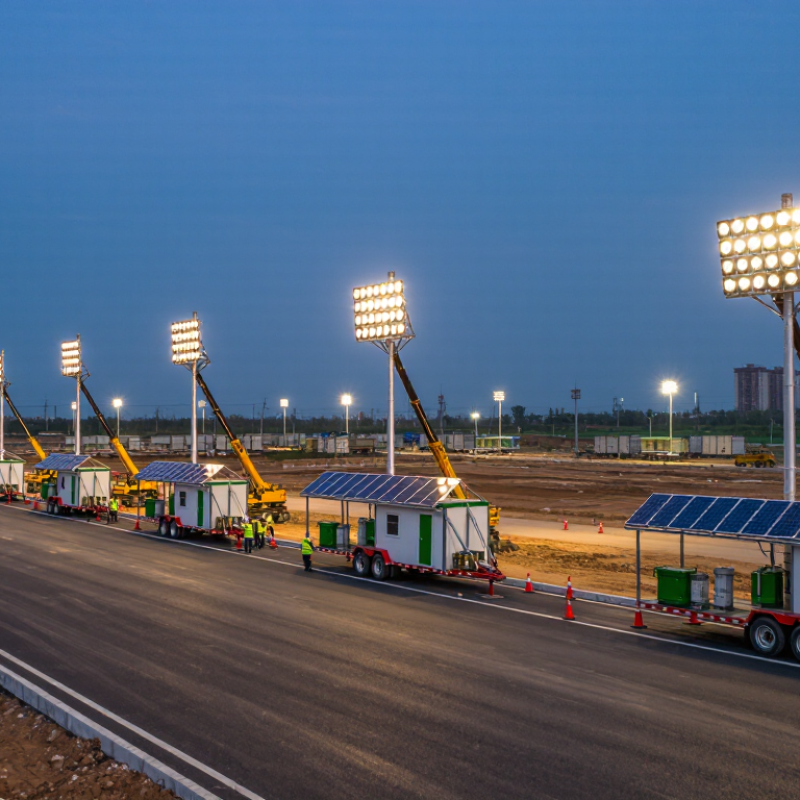
A solar light tower is a mobile lighting unit powered mainly by photovoltaic panels. It converts sunlight into electricity and stores energy in rechargeable batteries. At night, efficient LED fixtures illuminate work areas without continuous fuel consumption. The tower commonly includes a mast, battery enclosure, solar controller, wheels, and a trailer or skid frame. Some models use automatic dusk-to-dawn controls. Others require manual adjustment. That difference matters on a busy site.
In practical use, operators position the tower near road repairs, emergency response zones, farms, or temporary construction areas. A stable base reduces movement in wind. Adjustable lamps help direct light onto a trench instead of nearby homes. Good systems show battery status, charging performance, and operating hours clearly. Field experience shows that cable protection and weather sealing often matter as much as advertised brightness. A bright lamp is not enough.
When comparing solar light tower manufacturers in China, buyers should request verified test data, battery-cycle information, protection ratings, and service procedures. Ask how the unit performs after several cloudy days. This is where brochures can feel optimistic. Real output depends on season, latitude, dust, temperature, and panel angle. Buyers should also check mast locking, brake quality, spare-part access, and warranty terms. Independent certification supports confidence, but it does not replace a site trial. A small pilot can expose weak controls, slow charging, or inconvenient maintenance before a larger purchase.
A solar light tower is a mobile lighting system that uses photovoltaic panels, batteries, and LED lamps instead of a fuel-powered generator. The chart shows the calculated daily LED energy demand for a representative 400-watt lighting load at different operating schedules.
Calculation basis: daily energy demand = total LED load × operating hours. For example, a 400 W LED system operating for 12 hours uses 4.8 kWh per day. Actual solar light tower sizing also depends on sunlight hours, battery depth of discharge, weather conditions, and system losses.
China’s solar light tower manufacturers increasingly combine photovoltaic engineering, battery control, and portable construction design. Experienced suppliers usually offer adjustable solar panels, high-efficiency LED lamps, and lithium iron phosphate batteries. These components support longer operation during night work and cloudy conditions. A galvanized steel mast helps resist rain, dust, and frequent relocation. Check the enclosure rating, cable protection, and wind-load data before ordering.
Reliable manufacturers also provide practical control systems. Dusk-to-dawn sensors, programmable brightness, and remote monitoring can reduce unnecessary battery use. Some factories customize trailer size, mast height, lamp output, and charging capacity for roads, construction sites, or emergency areas. Professional suppliers should share test reports, production photos, installation guidance, and clear warranty terms. Factory visits or sample testing can reveal details that catalog images hide. A weak point remains: performance may drop sharply in long winter weather if the battery is undersized.
Tips: Ask for a seven-day field test. Compare real nighttime runtime, charging recovery, mast stability, and battery temperature. Confirm spare-part availability and service response times. Do not judge quality by solar panel size alone. A larger panel cannot fix poor battery management. Also inspect wheel locks, trailer brakes, grounding points, and lamp adjustment during a physical trial. These small details often decide whether the tower is genuinely useful.
| Evaluation Dimension | Common Market Specification | Key Feature of Chinese Manufacturers | Buyer Verification Point |
|---|---|---|---|
| Lighting Technology | High-efficiency LED modules, generally using 30–200 W LED systems | Modular LED assemblies, adjustable beam options, and replaceable light heads are widely available | Request LM-79 or equivalent photometric data, lumen output, beam angle, and LED service life |
| Solar Array | Photovoltaic capacity commonly ranges from approximately 100 W to 600 W, depending on lighting load | Monocrystalline panels, foldable layouts, and customized panel sizes are commonly offered | Check panel rated power, cell type, conversion efficiency, dimensions, and mechanical protection |
| Battery System | Lithium iron phosphate batteries are increasingly used; lead-acid options remain available for cost-sensitive projects | Battery capacity, enclosure design, battery-management systems, and installation position can often be customized | Confirm chemistry, nominal voltage, usable capacity, operating temperature, BMS functions, and cycle-life test method |
| Operating Autonomy | Many product designs target approximately 2–5 nights of backup, subject to location and operating profile | Dimming schedules, motion sensors, remote controls, and low-voltage protection can extend operating time | Evaluate autonomy using local solar radiation, winter conditions, daily lighting hours, and programmed dimming levels |
| Mast Height and Mobility | Telescopic mast heights commonly fall within approximately 5–10 m for portable lighting towers | Manual winches, hydraulic lifting systems, trailer-mounted frames, and compact transport configurations are available | Check maximum height, folded dimensions, total weight, lifting method, wheel or trailer requirements, and ground stability |
| Weather Resistance | Outdoor enclosures are commonly designed to IP65 or higher; impact protection may reach IK08 or above depending on the component | Powder-coated steel, aluminum housings, sealed cable glands, and corrosion-resistant fasteners are commonly specified | Ask for ingress-protection and impact-protection test reports, coating specifications, and salt-spray test results where relevant |
| Control and Monitoring | Photocell control, timer-based dimming, motion detection, and remote monitoring are common options | Control systems can be configured for standalone operation, wireless communication, or project-specific monitoring platforms | Confirm communication range, SIM or network requirements, software access, data ownership, and fault alerts |
| Electrical and Safety Compliance | Export projects may require CE, RoHS, EMC, low-voltage, battery-transport, or destination-country compliance documentation | Manufacturers commonly provide documentation packages tailored to the target market and project application | Verify certificates against the exact model, test laboratory, applicable standards, and production revision |
| Customization Capability | Common customization areas include LED power, battery capacity, mast configuration, trailer frame, control logic, and enclosure color | OEM and project-based manufacturing are widely used for infrastructure, construction, emergency, and event applications | Request engineering drawings, a bill of materials, prototype approval procedures, and change-control documentation |
| Quality Management | Export-oriented factories may operate under ISO 9001-based quality-management systems | Typical production controls include incoming-material inspection, assembly testing, charging tests, and final inspection | Review the quality certificate scope, inspection records, factory audit results, and sampling or acceptance criteria |
| Warranty and After-Sales Support | Product warranties commonly range from 2–5 years, depending on the system and contract | Remote troubleshooting, spare-parts supply, installation guidance, and replacement-component support are commonly offered | Clarify warranty exclusions, response times, spare-parts availability, battery replacement terms, and local service responsibilities |
Note: Specifications shown are representative market ranges rather than guarantees for every manufacturer or model. Final performance depends on system configuration, climate, installation conditions, and operating settings.
China’s solar light tower manufacturers mainly produce three practical types: mobile, fixed, and hybrid units. Mobile towers use trailer frames, foldable solar panels, battery cabinets, and telescopic masts. They suit construction sites, road maintenance, emergency response, and temporary outdoor work. A typical unit can be repositioned by a small vehicle, although uneven ground still affects stability.
Fixed solar light towers are designed for parking areas, rural roads, farms, and security zones. Their panels usually sit above the mast, while lithium batteries operate LED floodlights after sunset. IEA PVPS reported 456 GW of new solar capacity worldwide in 2023, pushing cumulative capacity beyond 1.6 TW. This rapid expansion supports broader solar-component manufacturing, but it does not prove every tower has equal quality. Specifications need checking.
Hybrid solar light towers combine solar charging with grid or backup generator input. They are useful in cloudy regions, winter projects, and locations needing continuous illumination. Some Chinese factories add remote monitoring, automatic dimming, motion sensors, and battery temperature protection. The U.S. Department of Energy notes that modern LED systems can achieve roughly 100–200 lumens per watt, but real tower performance depends on optics, dust, temperature, and battery losses. Numbers can look impressive. Field testing is still better. A serious buyer should inspect IP ratings, wind-load calculations, cycle-life data, mast locking points, and replacement-part access before comparing prices.
Design begins with the worksite, not the solar panel. Engineers assess night hours, wind load, soil conditions, transport limits, and required illumination. A tower may use adjustable LED heads, a galvanized mast, lithium battery cabinet, and a photovoltaic array. Control software manages charging, dimming, and automatic startup. Small details matter. Cable glands need seals. Hinges need protection against dust and rain.
In production, metal sections are cut, welded, drilled, and treated against corrosion. Workers check weld alignment before assembly. Solar modules are tested for output, while batteries undergo capacity and temperature checks. Each assembled unit may receive a simulated night-cycle test. Technicians inspect light distribution across a measured area, not just brightness at the lamp. This process reflects practical manufacturing experience, but factory results cannot represent every climate.
Design revisions often follow field feedback. A tower may perform well in a dry yard yet struggle with coastal salt or long cloudy periods. Engineers then adjust coating thickness, battery reserve, or panel angle. Not every prototype succeeds. That is useful. Reliable production depends on documented inspections, traceable components, and clear maintenance access. Buyers should review test records, protection ratings, spare-part plans, and local compliance evidence before selecting a Chinese supplier.
When evaluating a solar light tower manufacturer in China, inspect engineering evidence before accepting polished specifications. IRENA reported 346 GW of new solar capacity worldwide in 2023. This rapid growth increases component availability, but it also rewards rushed designs. Ask for independent test reports covering photovoltaic output, battery capacity, charging time, and lamp performance. A reliable supplier should explain results under weak sunlight, low temperatures, dust, and repeated cloudy days.
Visit the factory if possible. Watch battery assembly, wiring protection, controller testing, and final inspection. Check whether each tower receives a serialised test record. The enclosure should match the claimed IP rating, while hinges, locks, and cable glands should feel durable. Small details matter. A loose connector can disable a tower after rain.
Battery claims deserve extra questioning. BloombergNEF reported that lithium-ion battery pack prices averaged 139 dollars per kWh in 2023, yet lower prices do not guarantee longer service life. Request cycle-life data, usable capacity, replacement procedures, and warranty exclusions. Also compare actual lighting output, not only LED wattage. A 1,000-watt label may hide poor optical efficiency. No test is perfect. I would still request samples and operate them for several weeks before placing a large order. A supplier that accepts technical criticism is often more dependable than one offering only impressive brochures.
© Shipham Valves 2025. All Rights Reserved.
Website By PS Website Design Ltd
Request a Quote/Further Information
Download
We use cookies on this website, by continuing to browse the site you are agreeing to our use of cookies. Find out more.