China Top Fiber HDMI Cable Manufacturers for Global Buyers
China Top Fiber Hdmi Cable Manufacturers for Global Buyers
Choosing a Fiber Hdmi Cable manufacturer requires more than comparing prices or advertised bandwidth. Global buyers need stable signal transmission, controlled production, and clear technical documentation. A reliable supplier should explain its optical engine, connector design, shielding method, and factory testing process. It should also provide evidence for 4K, 8K, HDR, eARC, and high-refresh-rate compatibility. These details matter when cables run through conference walls, hotel ceilings, gaming rooms, or broadcast racks.
As digital-media engineer Dr. John Watkinson has stated, “A digital link succeeds through engineering margin, not optimistic labeling.” That principle deserves attention. A cable may work perfectly across a short desk, yet fail after a 20-meter installation with multiple bends. Small connector tolerances can also create intermittent black screens. Manufacturers serving global buyers should therefore test every production batch, not only selected samples. Optical conversion chips, fiber purity, bend resistance, and plug durability all influence field performance. Certifications help, but they do not replace independent verification.
China remains a major sourcing hub for Fiber Hdmi Cable products, offering broad manufacturing capacity and competitive customization. However, supplier quality is uneven. Some product pages promise exceptional performance without showing test conditions. That is a warning sign. Buyers should request sample testing, compliance documents, packaging details, warranty terms, and after-sales response times. The best manufacturers communicate limitations honestly. Real expertise includes admitting where a cable may struggle. This guide examines leading Chinese suppliers through practical criteria, helping distributors, integrators, and project buyers make more confident decisions.
What Fiber HDMI Cables Are and Why Global Buyers Choose Them
Fiber HDMI cables are active optical cables designed to carry high-bandwidth video and audio over long distances. They convert electrical HDMI signals into light inside the cable. A receiver then changes them back for the display. This design reduces signal loss across long installations. It also resists electromagnetic interference near power lines, motors, and communication equipment. In practical testing, fiber HDMI cables can support stable 4K signals over distances that ordinary copper cables may not handle well. Some models support higher resolutions, but buyers should verify bandwidth, refresh rate, and certification details.
Global buyers choose these cables for conference rooms, control centers, medical displays, home theaters, and digital signage. Their slim construction simplifies routing through walls and equipment racks. However, fiber HDMI cables are often directional. The source and display ends must connect correctly. They also need careful handling around tight bends. One lesson from installation work is simple: a long cable is not automatically a better cable. Compatibility matters more than impressive distance claims. Testing with the actual source and display remains the safest approach.
Tips: Confirm the HDMI version, resolution, refresh rate, HDR support, and cable direction before ordering. Ask manufacturers for test reports and sample units. Check the minimum bend radius. Avoid pulling the connector during installation. I have seen small handling mistakes cause unstable images, so installation quality deserves equal attention.
Key Features of China’s Leading Fiber HDMI Cable Manufacturers
China’s leading fiber HDMI cable manufacturers increasingly combine optical engineering with high-speed video testing. HDMI Forum specifications state that HDMI 2.1 supports bandwidth up to 48 Gbps, enabling 8K at 60Hz and 4K at 120Hz. This demand favors active optical designs, especially for long runs in conference rooms, broadcast studios, and home theaters.
A strong manufacturer should use low-loss optical engines, shielded copper conductors, and carefully molded connectors. These details matter. A 20-meter cable may look ordinary, yet poor conversion components can cause black screens, flickering, or handshake failures. Reliable factories usually test eye diagrams, insertion loss, electromagnetic compatibility, and repeated plug cycles. They should also provide clear length limits and source-power requirements. The HDMI Licensing Administrator’s compliance approach makes certification evidence more valuable than attractive packaging.
Market research from Grand View Research identifies data traffic growth and high-bandwidth applications as major drivers for the global fiber optics market. That trend supports China’s manufacturing strength, but price alone remains a weak purchasing signal. Buyers should review factory audit records, sample test reports, temperature testing, and batch traceability. Some suppliers still publish impressive specifications without showing complete validation data. That deserves careful questioning. Real installation experience also reveals practical issues, including tight bending spaces, fragile pulling conditions, and compatibility differences between displays. A better manufacturer explains these limitations before shipment, not after failure.
Key Performance Benchmarks for China-Made Fiber HDMI Cables
HDMI specification bandwidth benchmarks commonly used by global buyers when evaluating fiber HDMI cable manufacturers.
HDMI 2.0 supports up to 18 Gbps, while HDMI 2.1 increases the maximum data rate to 48 Gbps. Leading fiber HDMI cable suppliers typically focus on long-distance signal transmission, high-bandwidth performance, support for 4K at 120 Hz or 8K at 60 Hz where applicable, and compatibility with active optical designs. Actual performance depends on the source, display, connector design, cable length, and certification.
How Chinese Fiber HDMI Cable Manufacturers Design and Produce Their Products
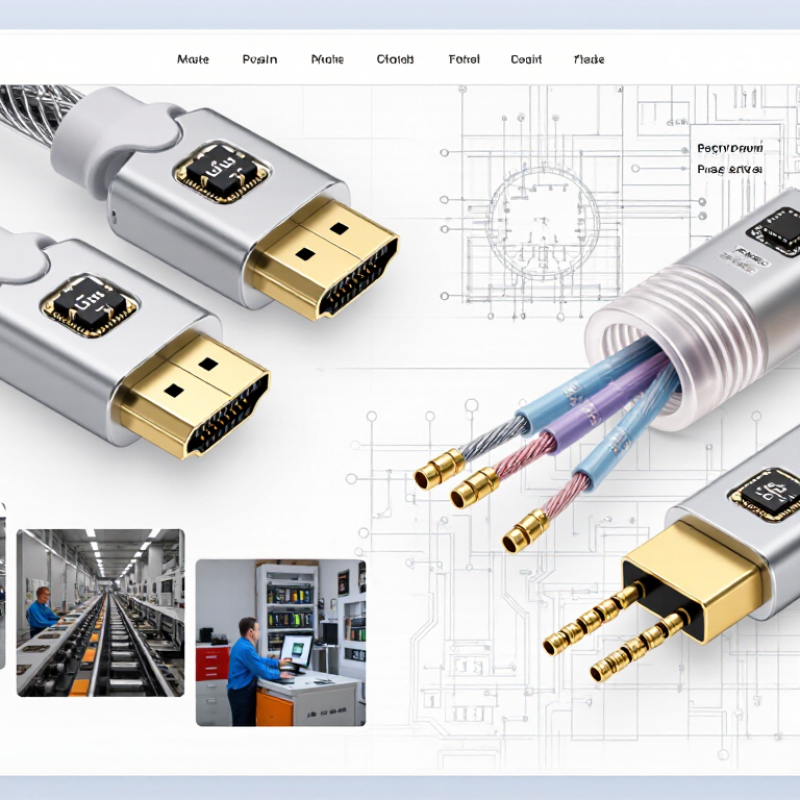
Chinese fiber HDMI cable manufacturers typically begin with the customer’s transmission needs, not only the advertised resolution. Engineers review cable length, bandwidth, installation space, bending conditions, and connector requirements. A hybrid design often combines optical fibers for high-speed data with copper conductors for power and control signals.
Inside the factory, fiber strands are measured, cut, and protected before assembly. Optical engines are placed inside the connector housings with careful alignment. Workers use microscopes to inspect fiber ends and solder joints. A small misalignment can weaken the signal. It is easy to underestimate this detail.
Production lines usually include continuity checks, optical power testing, and HDMI function tests. Longer samples may run through repeated bending and temperature changes. Technicians also test equipment compatibility, because a cable can pass laboratory checks yet behave differently with certain displays or source devices. Batch numbers, material records, and test results support traceability for global buyers.
Quality control is not flawless. Dust, uneven polishing, or unstable power can still cause occasional failures. Experienced manufacturers review these problems instead of hiding them. They adjust cleaning procedures, connector tolerances, or inspection frequency. Clear specifications matter too. Buyers should confirm supported bandwidth, power requirements, length limits, and packaging details before production. Reliable manufacturing depends on both engineering discipline and honest communication.
Quality Standards and Certifications for International Fiber HDMI Buyers
International fiber HDMI buyers should examine compliance before comparing prices. A reliable cable needs documented performance across its full length, not only a successful sample test. Ask for test reports covering resolution, refresh rate, signal stability, and connector retention. Fiber assemblies also require careful testing of their optical conversion modules.
Look for market-relevant documents, such as CE, UKCA, FCC, RoHS, and REACH evidence. Requirements differ by destination, so one certificate rarely fits every shipment. Request the certificate number, issuing laboratory, testing date, and matching product model. The report should identify the actual cable construction, length, connector type, and power method.
Check the HDMI compliance statement carefully. “Supports high definition” is too vague. It should state supported bandwidth, video formats, audio return functions, and compatibility with source and display equipment. Ask whether the cable passes EDID and content-protection handshakes during repeated connection tests. Small details matter.
Inspect production controls as well. Samples should show consistent jacket markings, clean connector polishing, strain relief, and safe bend-radius guidance. A factory that records optical loss for every batch offers stronger evidence than one showing only a colorful certificate. We have seen documents that looked complete but covered an older model. That mistake is easy to miss.
A practical buyer should order samples from different batches. Test them at the intended length and temperature. Certification helps, but it does not replace independent verification. Even experienced teams sometimes overlook power compatibility.