2026 Best Commercial Fan Types for Global Buyers?

Choosing the right Commercial Fan in 2026 requires more than comparing airflow figures. Global buyers must examine efficiency, noise, maintenance, controls, and local operating conditions. A warehouse in Dubai faces different challenges from a food-processing plant in Rotterdam. Dust, humidity, heat, and limited service access can change the best choice.

Dr. William P. Bahnfleth, a recognized HVAC and indoor-air-quality expert, has said, “Ventilation is not simply about moving air; it is about controlling where air goes.” This principle remains highly relevant when evaluating axial fans, centrifugal fans, exhaust fans, HVLS fans, and explosion-resistant industrial designs. Air volume matters. Air direction matters more.

The best fan is not always the largest or most powerful model. It should match the building envelope, duct resistance, occupancy, and duty cycle. Buyers should also review motor efficiency, variable-speed compatibility, corrosion protection, certifications, spare-part availability, and warranty support. Small details become expensive problems later.

Some decisions remain imperfect. Product data may use different testing methods, while regional suppliers may describe performance differently. Careful buyers should request certified curves, installation guidance, and references from comparable facilities. A quiet showroom test cannot represent a dusty production floor. Real conditions are less forgiving.

This guide compares the leading Commercial Fan types for global buyers in 2026. It focuses on practical selection, lifecycle value, and dependable performance rather than marketing claims. The goal is simple: move the right air, in the right direction, with fewer surprises.
2026 Best Commercial Fan Types for Global Buyers?

Commercial Fan Basics and Selection Criteria for Global Buyers

Commercial fan selection starts with the air duty, not the product label. Axial fans move large air volumes at low resistance. Centrifugal fans suit higher static pressure, filters, ducts, and heat exchangers. Mixed-flow designs can balance both needs. HVLS fans improve air movement across large warehouses, while exhaust fans remove heat, moisture, or airborne contaminants.

Global buyers should define airflow, static pressure, operating hours, temperature, humidity, and installation height. These details prevent costly mismatches. Select motors for the local voltage and frequency. Check IP protection, corrosion resistance, noise limits, vibration control, and variable-speed compatibility. AMCA testing methods help compare fan performance under controlled conditions. The UNEP 2024 Global Status Report for Buildings and Construction reports that buildings consume about 32% of global energy and create roughly 34% of energy-related emissions. Efficient fans and correct controls therefore matter beyond the equipment room. Real sites are rarely perfect, though. Dust, poor duct design, and seasonal changes can reduce expected savings.

Tips: Request a certified performance curve, not only a maximum airflow figure. Compare duty-point efficiency, sound levels, maintenance access, and warranty terms. Ask for test conditions and measurement tolerances. A small fan may appear cheaper, but it can struggle against pressure losses. Oversizing also wastes energy. Recheck the calculation with a local engineer.

2026 Best Commercial Fan Types for Global Buyers? – Commercial Fan Basics and Selection Criteria for Global Buyers

Commercial Fan Type Typical Airflow Range Typical Pressure Capability Best-Fit Applications Main Advantages Typical Limitations Key Selection Criteria
Axial Fan Approximately 1,000–120,000 m³/h Low to medium pressure; commonly up to about 500 Pa Warehouses, factories, agricultural buildings, general exhaust and supply ventilation High airflow, simple construction, compact installation, generally lower initial cost Less suitable for long duct systems or high-resistance filters Required airflow, static pressure, fan diameter, duty cycle, motor protection and weather resistance
Centrifugal Fan Approximately 500–100,000 m³/h Medium to high pressure; often 500–3,000 Pa or higher depending on design Ducted HVAC systems, dust extraction, process ventilation and air-handling equipment Performs well against duct resistance, filters and heat exchangers; broad operating range Usually larger, heavier and more costly than basic axial units Fan curve, system resistance, impeller type, efficiency, vibration control and maintenance access
Mixed-Flow Fan Approximately 1,000–30,000 m³/h Medium pressure; commonly about 300–1,500 Pa Commercial buildings, car parks, hotels and compact ducted ventilation systems Balances the airflow of axial fans with the pressure performance of centrifugal fans Performance depends strongly on correct duct sizing and system operating point Available space, duct layout, pressure loss, sound level, controllability and service life
Roof Exhaust Fan Approximately 500–40,000 m³/h Low to medium pressure; commonly up to about 800 Pa Factories, kitchens, workshops, warehouses and general building exhaust Saves indoor floor space and discharges contaminated air directly outdoors Roof penetration, weather exposure and access for maintenance must be considered Roof structure, rain protection, corrosion resistance, backdraft control and noise limits
High-Volume Low-Speed (HVLS) Fan Air movement is usually specified by coverage area rather than duct airflow Very low static pressure; designed for room air circulation Large warehouses, logistics centers, sports halls, workshops and livestock buildings Large air coverage, improved comfort, destratification and low operating speed Does not replace dedicated exhaust or filtered supply ventilation Ceiling height, blade diameter, mounting structure, clearance, controls and local safety requirements
Jet Fan Approximately 5,000–50,000 m³/h per unit Produces thrust for directional air movement rather than conventional duct pressure Underground car parks, tunnels and smoke-control ventilation systems Reduces ductwork in open spaces and supports directional airflow management Requires engineering design, coordinated controls and careful noise evaluation Thrust, airflow direction, reversible operation, fire-rating requirements, control logic and clearance
Kitchen Exhaust Fan Approximately 2,000–30,000 m³/h Medium to high pressure, often about 500–2,000 Pa Commercial kitchens, food-processing areas and grease-laden exhaust systems Designed for hot, greasy and contaminated air when correctly specified Needs regular cleaning; grease, heat and fire-safety issues increase maintenance requirements Temperature rating, grease management, cleanability, fire safety, duct velocity and access panels
Explosion-Protected Fan Approximately 500–50,000 m³/h, depending on configuration Low to high pressure, depending on fan construction Chemical plants, solvent rooms, fuel-storage areas and hazardous processing zones Supports ventilation in areas where flammable gas, vapor or dust may be present Higher purchase cost and strict installation, inspection and maintenance requirements Hazardous-area classification, temperature class, equipment category, certification, grounding and material compatibility
Global Buyer Selection Checklist: Confirm the required airflow in m³/h or CFM, total system pressure in Pa or in.w.g., operating temperature, humidity, dust or chemical exposure, noise limit, duty cycle, motor voltage and frequency, speed-control method, installation environment, spare-parts availability, warranty terms, and applicable local electrical and safety regulations. Fan performance should be evaluated at the actual system operating point rather than by airflow rating alone.
Technical Note: The airflow and pressure figures shown are general commercial selection ranges. Actual performance varies with fan diameter, impeller design, motor speed, air density, system resistance and operating conditions. Buyers should request certified fan curves, efficiency data, sound-power information and compliance documentation for the final model.

Axial Fans: Types, Uses, Advantages, and Limitations

Axial fans move air parallel to the rotating shaft, making them practical for high-volume, low-to-medium-pressure duties. Propeller fans suit open warehouses, agricultural buildings, and general exhaust. Tube axial fans use a cylindrical casing for better directional control. Vane axial fans add guide vanes, improving pressure performance and airflow stability.

That distinction matters.

Their advantages are clear. Axial units usually need less floor space than centrifugal equipment. They can deliver strong airflow through walls, roofs, tunnels, and cooling systems.

The IEA’s Energy Efficiency 2024 report states that electric motor systems consume more than half of global electricity. Fan efficiency therefore deserves serious attention.

The U.S. Department of Energy’s fan-system guidance identifies possible energy savings of 20–50% through proper sizing, controls, and maintenance.

These figures are useful, but actual savings depend on operating conditions.

Selection should begin with measured airflow, static pressure, temperature, humidity, and acoustic limits. A fan rated at 1,450 rpm may produce excessive noise near occupied work areas. AMCA Publication 203 stresses the importance of testing fan performance under defined conditions.

Field checks should include belt tension, vibration, filter loading, and unexpected duct leakage.

Small errors matter. Open propeller fans often lose performance against resistance, while vane axial fans cost more and require careful installation. Corrosive vapors, dust, and outdoor exposure may also shorten service life.

I would not treat catalogue efficiency as guaranteed savings. A cheaper fan can appear efficient on paper, then disappoint after dirty filters or poor control settings.

Centrifugal Fans: Designs, Applications, and Performance Features

For global buyers, centrifugal fans remain a practical choice for controlled air movement. Their wheel draws air through the inlet and redirects it outward through the housing. Backward-curved blades usually provide strong efficiency and stable operation. Forward-curved blades offer compact airflow at lower pressure. Airfoil designs can reduce turbulence, noise, and energy demand.

The housing shape strongly affects performance. A scroll casing can convert velocity into useful pressure. A plenum arrangement may suit systems requiring flexible discharge directions. These fans serve factories, warehouses, commercial kitchens, clean areas, and ventilation systems. In dusty environments, buyers should check wheel clearance, coating options, and access for cleaning. Moisture also matters. Ordinary steel may deteriorate quickly in humid service.

Performance data needs careful reading. Airflow, static pressure, speed, motor power, sound level, and efficiency should appear together. A fan that delivers impressive airflow at zero pressure may struggle inside long ducts. Request certified test data where possible, using recognized laboratory methods. Field experience shows that poor inlet conditions can create vibration and unexpected noise. Installation is not a minor detail. Flexible connectors, balanced supports, and suitable filters can protect the system.

Some selections deserve a second review. Oversizing may increase purchase cost and throttle losses. Undersizing may leave rooms hot, smoky, or uncomfortable. Buyers should compare the actual duty point, maintenance access, local power supply, and spare-part availability before approving a centrifugal fan.

Industrial, HVLS, Exhaust, and Portable Commercial Fan Options

2026 Best Commercial Fan Types for Global Buyers?

Industrial, HVLS, Exhaust, and Portable Commercial Fan Options

Commercial fan selection depends on airflow goals, room size, and operating conditions. Industrial fans suit workshops, warehouses, and production areas needing strong, continuous circulation. Check airflow volume, static pressure, motor duty, noise, and maintenance access before ordering. A powerful motor alone does not guarantee useful performance.

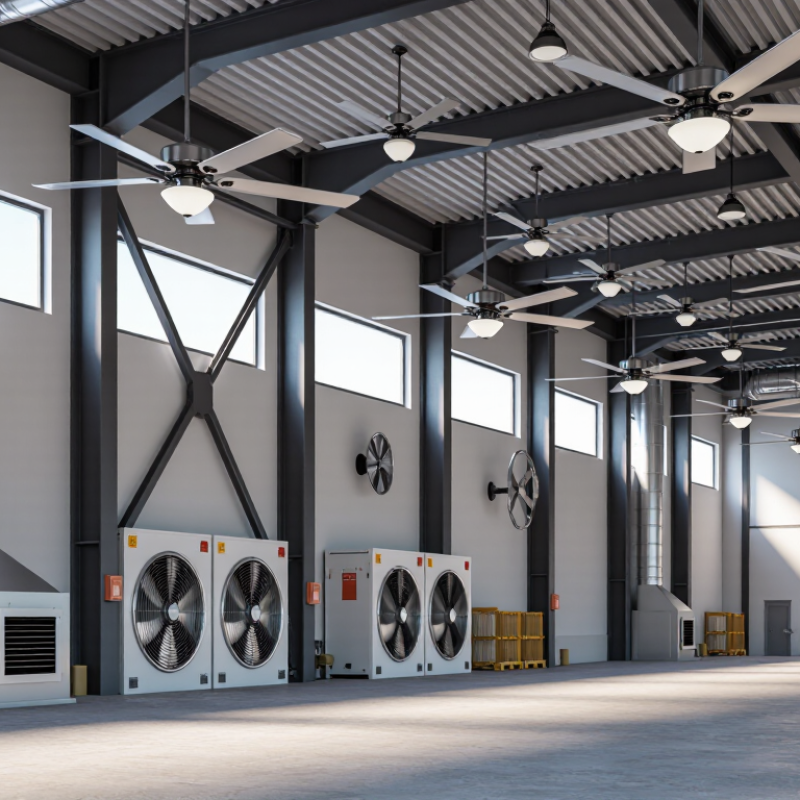
HVLS fans move large air volumes slowly across high ceilings. They can reduce stagnant zones and improve comfort in warehouses, gyms, and logistics spaces. Blade diameter, mounting height, control range, and ceiling structure need careful review. I have seen oversized units create uncomfortable drafts near workstations. Bigger is not always better.

Exhaust fans remove heat, moisture, fumes, or stale air from enclosed areas. Buyers should verify duct length, resistance, corrosion exposure, and required air changes. Portable commercial fans offer flexible cooling during maintenance, events, or temporary construction work. Their wheels, cable length, noise level, and safety grille matter in daily use. Confirm voltage and frequency before international shipment. Regional electrical requirements may differ, even between nearby markets.

A reliable specification sheet should show tested airflow data, sound levels, power consumption, and operating limits. Ask for installation guidance and replacement-part availability.

Product photos can hide awkward access points. That detail is easy to miss. Exact sizing may still require a qualified ventilation professional, especially where heat, dust, or hazardous fumes are present.

How to Compare Energy Efficiency, Standards, Costs, and Suppliers

Choosing the best commercial fan in 2026 requires more than comparing airflow and purchase prices. The IEA’s Buildings 2024 report states that buildings consume about 30% of global final energy. Fan efficiency therefore affects operating budgets and carbon targets. Axial fans suit large, open spaces, while centrifugal fans handle higher resistance in ducted systems. Mixed-flow models can balance pressure, noise, and space limitations.

Compare the Fan Energy Index, or FEI, under AMCA 208. A higher FEI usually indicates better efficiency at the same duty point. Check airflow, pressure, sound, motor efficiency, controls, and part-load performance together. Regional standards also matter. Verify applicable safety, electromagnetic compatibility, and energy-efficiency requirements before ordering. A certificate alone does not prove suitability. I have seen efficient fans perform poorly after incorrect system sizing.

Tips: Request test data from an accredited laboratory. Ask suppliers for duty-point curves, spare-part prices, warranty terms, and delivery records. Estimate five-year lifecycle cost, including electricity, maintenance, controls, and downtime. The U.S. Department of Energy recommends evaluating commercial equipment through measured performance, not marketing claims. Energy prices vary widely, so use local tariffs and realistic operating hours. A low-cost fan may become expensive in a dusty warehouse. Suppliers should also explain inspection procedures, factory quality controls, and after-sales support. That detail is easy to overlook.

2026 Best Commercial Fan Types for Global Buyers

The chart compares representative specific fan power under each fan type’s normal commercial operating range. Lower values indicate less electricity used to move 1,000 m³ of air. Actual results depend on airflow, pressure, controls, motor loading, installation, and duty cycle.

Fan type Typical specific fan power Common application Buyer checks
HVLS ceiling fan 8–18 W per 1,000 m³/h Warehouses, factories, sports halls Air circulation area, noise, safety, controls
Axial exhaust fan 18–35 W per 1,000 m³/h General ventilation and exhaust System resistance, backdraft protection, corrosion class
Forward-curved centrifugal fan 25–45 W per 1,000 m³/h Compact air-handling equipment Operating point, belt losses, filter loading
Backward-inclined centrifugal fan 20–35 W per 1,000 m³/h Industrial ventilation and air-handling units Total efficiency, variable-speed control, sound power
EC plug fan 15–28 W per 1,000 m³/h Modern AHUs, cleanrooms, data facilities Integrated drive, EMC compliance, serviceability

For international purchasing, request certified performance data measured to applicable AMCA or ISO test methods, verify regional electrical and EMC requirements, and compare total cost of ownership rather than purchase price alone. Relevant references may include AMCA 208 for Fan Energy Index calculations, AMCA 210 or ISO 5801 for fan performance testing, and IEC 60034 requirements for rotating electrical machines.

Request a Quote/Further Information

    Download